
A lot of time gets spent asking whether the service desk is still relevant. The more useful question is: what does the service desk need to become, and how do we get there?
The scale of the industry makes the case clearly enough. Based on data from several sources, including Gartner, FMI, and CompTIA, approximately 20-25 million people work in service desk roles globally, and the Service Desk/ITSM market for products and services sits between $20 and $30 billion. The estimated number of active service desks worldwide ranges from 500,000 to 2,000,000. The function isn’t going anywhere – not for now anyway.
AI is raising the bar for human interaction, not lowering it
As AI handles more of the transactional work, the interactions that reach a human are, by definition, the ones that couldn’t be automated. They’re the complex cases, the emotionally charged situations, the moments where someone needs to be understood rather than processed. That puts considerably more pressure on the quality of those interactions, not less.
The research is consistent on this. MIT Sloan’s research from March 2025 found that AI is more likely to complement human workers than replace them. McKinsey’s January 2025 data found that only 1% of business leaders describe their organisations as mature in AI deployment. And research by Mäkelä and Stephany published in February 2025 found that the complementary effects of AI on human skills are up to 1.7 times larger than the substitution effects.
The picture that’s emerging is one of rebalancing. If automation is absorbing the volume, the remaining human interactions need to be of a significantly higher quality. There’s less tolerance for missed cues or for failing to understand the context. The service experience, when it happens human-to-human, has to be exemplary.
The three levels of a service desk interaction
Every service interaction operates at three levels simultaneously, and good service desk professionals move across all three in real time:
- Technical: identifying and clarifying what the issue actually is.
- Business: understanding the operational context, the impact, the urgency, and what the outcome needs to look like.
- Human: recognising the customer’s emotional state, whether they’re frustrated, anxious, or simply exhausted by a problem that’s gone on too long.
It’s a genuinely sophisticated skill, and one that doesn’t get nearly enough recognition. Organisations doing this well are hiring people who can read a situation, adapt their communication style on the fly, and hold a conversation at the right level for the person in front of them. Some people are naturally good at this. Others can be developed. But it has to be a deliberate priority.
Stakeholder management isn’t just for consultants
There’s a tendency to treat stakeholder management as something that happens above the service desk, a practice reserved for project managers, directors, and account managers. I’d argue that’s the wrong way to think about it. The service desk is one of the best environments in the business to learn stakeholder management. Every interaction is a version of reading a room, managing expectations, and delivering under pressure.
At the individual level, stakeholder mapping is a useful tool for anyone managing relationships with more than a handful of people. A basic stakeholder profile captures a person’s role, working style, preferred communication method, what motivates them, what creates friction, and where the relationship currently sits on the spectrum from actively engaged to actively resistant. The more transparent you can make the process, the better it tends to work. It’s about building a clearer picture of the people you’re working with, so your approach is better calibrated to them.
Stakeholder Map
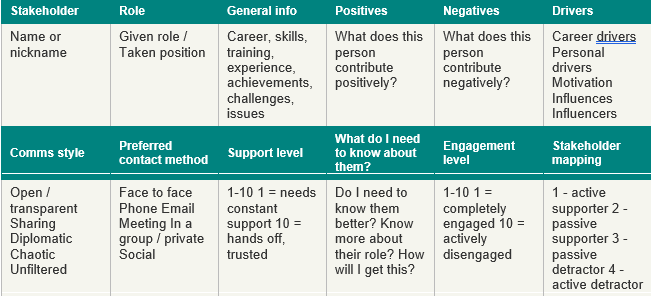
Complete one of these for each person you need to work with, and you’ll quickly build a picture of where the relationship sits and what you need to do to move things forward. The scoring on support level and engagement level gives you a baseline you can track over time.
Profiling and personas at the organisational level
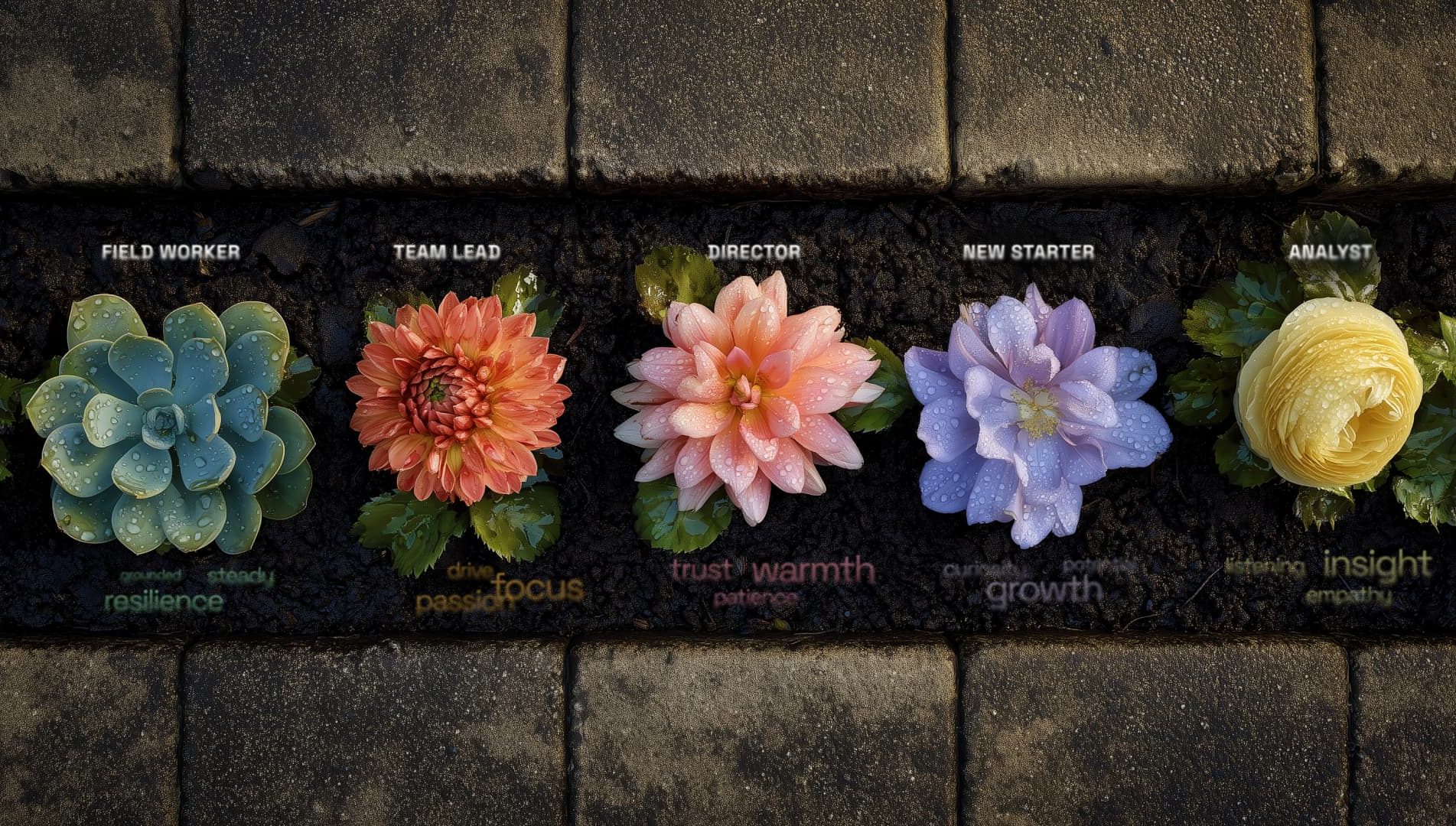
Moving from individuals to the broader user community, the same logic applies. Rather than treating all users as broadly equivalent, teams that have invested in building personas — giving names and characteristics to different user types — report better empathy, better communication, and better outcomes.
I’ve seen this work in a global charity where field workers, high-street fundraisers, and in-office staff all had fundamentally different needs, expectations, and working contexts. I’ve seen it work in a professional services firm where fee earners and their PAs needed entirely different approaches. It works in university environments, in NHS trusts, and in any setting where the user base is varied, and context shapes how people need to be supported.
The connection to experience management is worth making explicit. If you’re moving from SLA-based measurement to XLAs, you need to know who you’re measuring experience for. Applying experience targets to defined personas gives the data meaning and makes the case for the service desk’s contribution much clearer.
Profiling / Personas
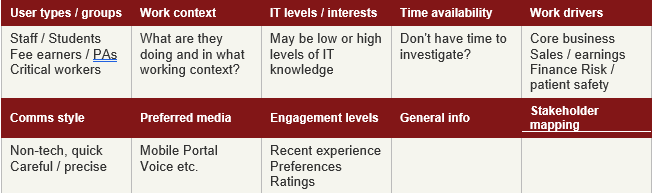
Whether these profiles end up embedded in your service management tool or displayed in the team’s working environment, the principle is the same: give your people a structured way to think about who they’re talking to, not just what the ticket says.
Building trust takes more than intent
Stakeholders respond to your purpose and motivation, not just your words. If people sense you’re going through a process rather than trying to help them, the conversation won’t work. Making your intention explicit and making sure your actions are consistent with it is part of the job.
Empathy takes investment. Listening is different from waiting for someone to finish speaking. Genuinely connecting with why a stakeholder feels the way they do, and showing that you’ve understood it, is what separates a functional interaction from one that builds the relationship over time.
Trust is fragile. Avoid responses that don’t reflect the specific situation, align your actions to what the person in front of you actually needs, and show consistent follow-through.
Where the service desk goes next
The service desk’s future isn’t in the volume of tickets it resolves. It’s in the quality of the relationships it holds, the depth of the business context it carries, and the capability of the people who do the work. Some of those people will move into DEX teams and broader service management functions, and that’s a natural progression, because they already understand the business and the people within it.
The organisations making progress are those that give their people a structured way to think about relationships, communication, and trust. Service desks have come a long way from the ‘unhelpful desk’ of the 1990s. The next stage of that progress is fundamentally human. If you’d like to talk about how this works, get in touch.